Serves
4 to 6
I
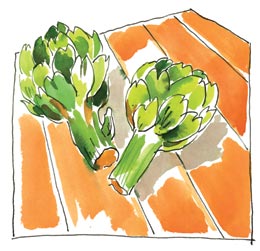
share with Caterina de’ Medici a passion for artichokes, which are said to
be right up there with oysters and caviar as an aphrodisiac. But it’s really
the taste that drives me mad.
 Legend
has it that an Arab farmer’s beautiful daughter observed her donkey eating
strange thistles. She tried them herself, first raw, then grilled, and finally
she stewed them with herbs (most likely wild mint and garlic) and sold them at
her local market. A prince got wind of the new delicacy, met the cook, and they
lived happily ever after, no doubt enjoying their newfound love potion.
Legend
has it that an Arab farmer’s beautiful daughter observed her donkey eating
strange thistles. She tried them herself, first raw, then grilled, and finally
she stewed them with herbs (most likely wild mint and garlic) and sold them at
her local market. A prince got wind of the new delicacy, met the cook, and they
lived happily ever after, no doubt enjoying their newfound love potion.
Historically,
wealthy Romans, to protect their precious supply of carciofi, forbade the masses
to buy or eat them. The Roman naturalist Pliny pointed out in his disdainful discourses
on the Roman class system that “artichokes were discovered by asses and are
still being consumed by them.”
If
you rarely have artichokes in your markets, you may substitute frozen ones, but
the results will not be quite the same. Still, they will be tasty and most certainly
whet your appetite for an excursion through the silvery fields south of Rome.
The medium-sized artichoke with the name romanesco is used for this dish, but
use whatever artichokes you can find.
Some
of the best artichokes in Rome are served at Nino, just off the Piazza d’Espagna
on via Borgognona, and Trattoria 31 on via delle Carrozze. Sometimes Carciofi
alla Romana are a bit too salty, but quaffing a little more vino sciolto, the
lovely low-alcohol white wine from Frascati, will take care of that.
1/2
cup extra virgin olive oil
6 medium globe or 20 baby artichokes, leaves trimmed
down to the yellow part, stems peeled,
and greenish tops cut off to the yellow part
6 garlic cloves, chopped
4
fresh mint sprigs, leaves only
1/2 teaspoon salt
1/2 cup dry white wine
or water
1 large lemon
Heat
the olive oil in a large pot with a lid over medium heat, then add the artichokes,
cutting each in half if you like to create more surface area to be browned. Cook
for a few minutes, until golden, turning once, then add the garlic, mint leaves,
and salt. Cover and simmer for 6 to 7 minutes, then add the wine or water, lower
the heat, cover, and continue cooking for 15 to 20 minutes, until the artichokes
are very tender. Squeeze the lemon juice over the artichokes and serve at room
temperature in the oil.
Variation:
Puree
the mixture in a food processor with 2 cups Brodo di Pollo or Brodo di Verdure
(page 69 or 71) and a dash of cayenne and toss with any short pasta such as penne
or ziti.
.
. . . . . . . . . . . . . . . . . . . . . . . . . . .
Refrigerate
fresh artichokes before peeling and the outer leaves will snap off easily. Once
you’ve pared and trimmed them, toss them with lemon juice and store in a
resealable plastic bag in the refrigerator. They will stay green and fresh for
2 to 3 days. Any discoloration disappears in cooking.
Return
to Top of Page

Serves
4
When
I serve this intense, lemony pasta, my guests practically faint with pleasure.
It is one of those easy dishes that knocks your socks off. Lemon, cream with just
a touch of garlic, and Parmesan will elevate any everyday fresh pasta to grandeur.
You need not serve huge plates of this pasta if you 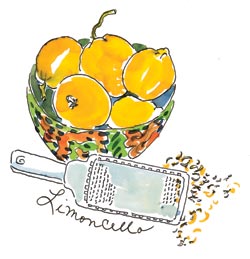 are
serving a second, because it is rich and filling. Use Eureka lemons, if possible,
since their zest is thick and tasty.
are
serving a second, because it is rich and filling. Use Eureka lemons, if possible,
since their zest is thick and tasty.
2
tablespoons butter
1 very tiny dried hot red pepper, crushed
1 small garlic
clove, quartered
3 cups heavy cream
3 large lemons
1 recipe Pasta all’Uovo
(page 88), cut into fettuccine
2/3 cup grated Parmigiano-Reggiano
Freshly
ground pepper or chopped fresh flat-leaf parsley for garnish (optional)
Bring
a large pot of salted water to a boil and have 4 warm pasta bowls ready.
In
a large skillet, heat the butter to bubbling, add the pepper and garlic, and cook
over medium heat until the garlic is golden, about 2 minutes. Remove the garlic
and add the cream. When the cream is simmering, add the pulp and grated zest (no
white attached) of 2 of the lemons and let the sauce reduce by about one quarter,
which should take about 4 to 5 minutes.
When
the sauce has thickened, cook the fettuccine in the boiling water for a few minutes,
until al dente, and while it is cooking add the juice of the remaining lemon and
half the Parmigiano-Reggiano to the cream sauce. Drain the pasta well and toss
with the lemon sauce. Sprinkle with pepper or parsley, if desired, and serve with
the remaining Parmigiano-Reggiano.
Return
to Top of Page

Serves
4
A
fritto misto, also called frittura di paranza, 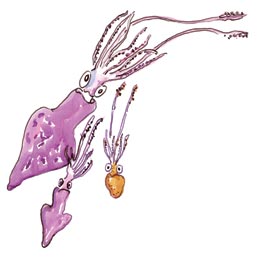 contains
anything small that is fresh that day at the fishmonger, but calamari and little
latterini, a tiny sliver of a fish similar to our whitebait, are almost always
included. You may order whitebait and sometimes fresh anchovies from your fishmonger,
but in a pinch, frozen whitebait work very well.
contains
anything small that is fresh that day at the fishmonger, but calamari and little
latterini, a tiny sliver of a fish similar to our whitebait, are almost always
included. You may order whitebait and sometimes fresh anchovies from your fishmonger,
but in a pinch, frozen whitebait work very well.
Extra
virgin olive oil for frying
1 pound whitebait
1 pound squid, cleaned and
cut into rings (page 37), tentacles left whole
1 pound small shrimp
Pastella
II from Alici o Latterini Fritti (page 30)
Lemon wedges
Heat
1 inch of olive oil until just beginning to smoke in a large deep skillet. Dip
the fish in the batter and fry for 3 to 4 minutes, until very crisp and golden.
Place a napkin on each plate, divide the fish among the plates, and serve with
lemon wedges.
.
. . . . . . . . . . . . . . . . . . . . . . . . . . .
To
tenderize larger, possibly tougher, calamari for frying, simmer the pieces in
2 tablespoons extra virgin olive oil, 1/2 cup white wine, and a little salt, covered,
over low heat for about 15 minutes. Drain and reserve the broth for another dish
such as Risotto alla Pescatora (page 142) or Zuppa di Pesce (page 80). Dip the
calamari in the batter and fry.
Return
to Top of Page